
Full Story ❤️
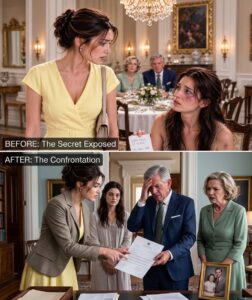
Claire Whitmore had always believed her life was built on solid ground. At twenty-eight she worked as a junior attorney in Charleston, drove a reliable car, and returned every other weekend to the sprawling Whitmore estate on the outskirts of the city. The house had been in the family for three generations—white columns, manicured lawns, a dining room that could seat twenty without feeling crowded. Her grandparents, Eleanor and Richard Whitmore, were the picture of Southern grace. Richard still ran the family’s shipping interests from a downtown office; Eleanor hosted charity luncheons and never raised her voice. Claire’s mother, Margaret, had died when Claire was twelve, and her father had drifted away years earlier. The grandparents had raised her. They were all she had left.
Or so she thought.
It began on a humid Thursday evening in late September. Claire had driven out after work, planning only a quiet dinner and an early night. The moment she stepped into the foyer she felt the air change. The usual scent of lemon polish and fresh flowers was undercut by something sharper—fear, maybe, or the metallic tang of blood.
She found her in the dining room.
The woman sitting at the long mahogany table looked as if she had crawled out of a nightmare. Long dark hair hung in tangled strands across her face. One eye was swollen nearly shut. A purpling bruise marked her cheekbone, and another darkened the skin of her upper arm. Her clothes were torn at the shoulder. She held a crumpled piece of paper in one trembling hand.
Claire stopped in the doorway. “Who are you?”
The woman lifted her head. For a moment the resemblance was so strong Claire’s breath caught. Same dark eyes. Same sharp jawline. Same small mole just below the left ear that Claire had always thought was unique to her mother.
“My name is Rose,” the woman said, voice raw. “Rose Whitmore. And this—” she held out the note—“was left on the gate this afternoon.”
Claire took the paper. The handwriting was hurried, almost frantic:
COME BACK AT 10 P.M.
YOU WILL SEE
Behind them, the soft clink of China. Eleanor and Richard sat at the far end of the table as if nothing were wrong. Eleanor’s hands were folded neatly in her lap. Richard’s face was carefully blank.
“Claire, darling,” Eleanor said, “this is a private family matter. You shouldn’t have come tonight.”
Claire’s voice shook. “She’s sitting at our table with bruises on her face and a note that sounds like a threat. What is going on?”
Rose spoke before either grandparent could answer. “I’ve been living in a small apartment on the east side for the last eight years. They paid the rent. They paid for the medication. They paid to keep me quiet. Tonight someone left that note on my door. I came here because I didn’t know where else to go.”
Richard stood. “That’s enough.”
“No,” Rose said, and the word carried a lifetime of held-back fury. “It isn’t enough. Not anymore.”
Claire looked from Rose to her grandparents and back again. The resemblance was no longer subtle. It was undeniable. “You’re my mother’s sister,” she whispered.
Rose’s damaged eye filled with tears. “I’m your mother’s twin.”
The words landed like a physical blow. Claire had grown up believing Margaret was an only child. There were no photographs of aunts, no stories of cousins, no mention of anyone else in the family tree. Eleanor and Richard had always spoken of Margaret as their sole daughter, their greatest joy, their greatest loss.
Rose continued, voice low and steady. “We were born in 1968. Identical. When we were sixteen, I became pregnant. The boy was the gardener’s son. Your grandparents decided the scandal would ruin everything. They sent me away to a private facility in Virginia. They told everyone I had gone to study abroad. When the baby was born—healthy, a girl—they took her. They told me she had died. They told Margaret I had died. They paid the facility to keep records sealed. I tried to come home once. Richard met me at the gate with a check and a warning. I took the money because I had nowhere else to go.”
Eleanor’s face had gone the color of old parchment. “You were unstable. You still are.”
“I was seventeen and terrified,” Rose answered. “You took my child and erased me.”
Claire’s mind raced. The child. A girl born to Rose in 1984. Claire herself had been born in 1996. The numbers didn’t match for her own birth, but the implication was clear: somewhere there was another daughter, another secret.
Richard’s voice was cold. “We did what was necessary to protect this family.”
“You did what was necessary to protect your reputation,” Rose said. “And you’ve been paying me to stay invisible ever since. Until tonight. Someone knows. Someone left that note.”
Claire stared at the paper again. COME BACK AT 10 P.M. YOU WILL SEE. The handwriting was not Rose’s. It was deliberate, almost elegant, the kind of script that belonged to someone who had practiced control for decades.
She looked at her grandparents. “Who else knows about this?”
Neither answered.
Claire turned to Rose. “Come with me.”
They left the dining room together. Behind them Eleanor called Claire’s name once, sharply, but Claire did not stop. She led Rose upstairs to the guest suite, found clean clothes, a first-aid kit, and a glass of water. While Rose cleaned the blood from her lip, Claire stood at the window and watched the long driveway. The note had said ten o’clock. It was already half past nine.
At 9:57 a pair of headlights swept across the lawn.
Claire went downstairs alone. She opened the front door just as a man in a dark suit stepped out of a black sedan. He was older, silver at the temples, carrying a leather portfolio. He looked at Claire the way people look at someone they have studied from a distance.
“Miss Whitmore,” he said. “My name is Daniel Hayes. I represent the estate of Thomas Caldwell. Your grandfather’s former business partner.”
Claire stepped aside and let him in.
What followed was not a conversation so much as a controlled demolition. Hayes opened the portfolio on the dining-room table and began laying out documents. Bank statements. Property transfers. A sealed adoption file from 1985. Medical records from the Virginia facility. A series of payments, regular and precise, that had continued for more than thirty years.
And then the final piece: a handwritten letter from Margaret Whitmore, dated two weeks before her death.
Claire read it standing up, one hand braced on the table.
Margaret had known. She had found Rose. She had planned to bring her home, to force the truth into the open. She had written to Caldwell for help. The letter ended with a single line: If anything happens to me, make sure Claire learns the truth.
Margaret had died in a single-car accident on a clear night with no skid marks.
Hayes’s voice was quiet. “Your mother asked us to hold these documents until Claire was old enough to understand. She never got the chance to finish what she started. Someone has been watching the payments. Someone left that note for Rose tonight because the money stopped last month. Your grandfather cut her off.”
Richard stood at the head of the table, face gray. Eleanor sat very still.
Claire looked at them both. “You took her child. You erased her life. And when my mother tried to undo it, she died.”
“We never—” Richard began.
“Don’t,” Claire said. “Not another word.”
She turned to Rose. “We’re leaving. Tonight.”
They did not pack. Claire simply walked Rose out the front door and into her car. Behind them the grand house glowed with warm light, the chandelier still bright, the dining table still set for a family that no longer existed.
In the days that followed, Claire did not sleep much. She filed motions. She requested sealed records. She sat with Rose in a quiet conference room while lawyers explained blood tests and inheritance statutes and the statute of limitations on fraud. The DNA results came back in eleven days. Rose was Margaret’s twin. The child taken in 1985 had been placed with a family in Savannah under a closed adoption. That child was now forty-one years old and had a daughter of her own.
Claire found her.
Her name was Lena. She lived in a modest brick house with a porch swing and a yellow dog. When Claire and Rose knocked on the door, Lena opened it holding a toddler on her hip. The toddler had the same dark eyes, the same small mole beneath the left ear.
There was no dramatic collapse, no shouting. Just a long silence while three generations of women looked at one another and recognized the shape of the missing pieces.
The confrontation with Richard and Eleanor came three weeks later in the study of the Whitmore house. Claire laid the documents on the desk one by one. The adoption file. The payment ledgers. Margaret’s letter. The medical records that proved Rose had never been “unstable,” only pregnant and alone.
Richard put his hand to his forehead as if the weight of the paper itself was too much. Eleanor stood beside him, lips pressed white. Lena stood in the doorway, quiet and watchful. Rose sat in a chair near the window, the bruises on her face already fading to yellow.
Claire spoke without raising her voice. “You will sign every document my attorneys put in front of you. You will release every trust that was built on silence. You will never contact Rose or Lena or me again unless we ask. And you will live with the knowledge that the family you protected was never real.”
Richard signed. Eleanor signed. The family photograph on the desk—Richard, Eleanor, and a young Margaret—seemed to watch the entire scene without expression.
When it was finished, Claire walked out of the house for the last time. Rose and Lena followed. The three of them stood for a moment on the wide front steps while the late afternoon light turned the columns gold.
Rose touched Claire’s arm. “She would have been proud of you.”
Claire looked back at the house one final time. The chandelier was still lit in the dining room. The long table was empty.
“I know,” she said.
They drove away together, the note that had started everything folded carefully in Claire’s purse. COME BACK AT 10 P.M. YOU WILL SEE.
They had come back.
They had seen.
And the secret that had held three generations in its grip was finally, irrevocably, finished.