
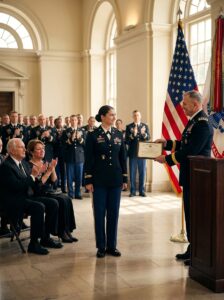
Part 1: The Name That Was Erased
“What the hell is she doing here?”
My father muttered the words so quietly that most people in the room never heard them.
I did.
I always heard my father.
Even when he whispered.
Even when he pretended I wasn’t there.
Even when he spoke about me as if I were a stranger.
I stood near the back of the military auditorium, perfectly still.
The room was filled with officers.
Colonels.
Generals.
Commanders.
Veterans.
Family members.
Reporters.
People who had come to celebrate Lieutenant General Harlan Vale’s forty years of military service.
My father’s retirement ceremony.
The ceremony he had spent months planning.
The ceremony where my name had been deliberately removed from the guest list.
And yet I was standing there.
In uniform.
Not as the forgotten daughter.
Not as the difficult child.
Not as the family embarrassment.
But as someone my father had spent twenty years pretending did not exist.
The installation commander stepped toward the podium.
He looked across the audience.
Then he smiled.
“Ladies and gentlemen,” he announced, “today we recognize one of the most distinguished officers in the history of this command.”
The audience applauded.
My father smiled.
His shoulders straightened.
For a moment, he looked exactly like the man I remembered from childhood.
Untouchable.
Powerful.
Certain that every room belonged to him.
Then the commander continued.
“But before we complete today’s retirement ceremony, there is one final recognition.”
The applause slowly faded.
My father’s smile disappeared.
The commander turned toward the side entrance.
“Please stand.”
Everyone stood.
I remained where I was.
The commander looked directly at me.
“Brigadier General Sable Rowan Vale.”
The room exploded with applause.
For several seconds, I could not move.
Not because I was surprised.
Because I was remembering.
The little girl who had once stood in her father’s shadow.
The teenager who had been told she was too stubborn.
The young woman who had left home without saying goodbye.
The officer who had spent two decades serving in places where her name was never allowed to appear in public.
The daughter who had become a general.
And suddenly, everyone knew.
Everyone except the people sitting in the front row.
My mother.
My brother.
And my father.
They stared at me as though they had just seen a ghost.
My mother slowly lowered her hands.
My brother’s mouth opened.
His fiancée stopped smiling.
And my father…
My father looked terrified.
Not proud.
Not emotional.
Terrified.
The commander walked toward me.
“General Vale,” he said.
I stepped forward.
“Yes, sir.”
He shook my hand.
Then he turned toward the audience.
“Some careers are measured by medals.”
The room became silent.
“Some are measured by commands.”
He paused.
“And some are measured by the number of lives that never had to be mourned because someone was willing to stand in the dark.”
My father’s face became pale.
The commander continued.
“General Sable Vale spent most of her career in classified military intelligence.”
A murmur moved through the room.
“Her missions cannot be described here.”
“Her accomplishments cannot be fully listed.”
“And many of the people she protected will never know her name.”
I looked at my father.
He looked away.
The commander raised his voice.
“Today, we correct one thing.”
He turned toward me.
“We make her name impossible to erase.”
The audience stood again.
This time, the applause lasted much longer.
I heard someone behind me whisper:
“That’s his daughter?”
Another voice answered:
“I thought he only had a son.”
My chest tightened.
Because that was exactly what my father wanted people to believe.
For years.
But the truth was finally standing in the middle of the room.
And this time…
It was wearing stars.
Part 2: The Daughter Nobody Talked About
My name is Sable Rowan Vale.
I was born into a military family.
My father believed discipline was love.
My mother believed appearances were survival.
My younger brother Penn believed the world owed him something because of our father’s rank.
And I learned very early that there was no place for weakness in our house.
My father never hit me.
He didn’t need to.
His silence was enough.
If Penn came home with a trophy, my father displayed it.
If I came home with perfect grades, he nodded.
If Penn struggled, my father called it pressure.
If I struggled, my father called it failure.
When Penn said he wanted to join the military, my father threw a celebration.
When I said the same thing, my father laughed.
“You?”
I was sixteen.
I remember standing in the kitchen.
I remember the glass of water in my hand.
I remember my mother staring at the floor.
My father shook his head.
“You won’t last six months.”
I said nothing.
He continued.
“You’re too emotional.”
I looked at him.
“I’m not emotional.”
He smiled.
“That’s exactly what an emotional person would say.”
Penn laughed.
My mother laughed too.
I didn’t.
That night, I went upstairs.
I opened my bedroom window.
The air was cold.
I sat on the roof and looked at the stars.
And I made myself a promise.
One day, I would become someone they couldn’t dismiss.
I didn’t know then how expensive that promise would become.
My military career began quietly.
No family celebration.
No photographs.
No newspaper article.
No proud father standing beside me.
I left home with two bags.
My mother hugged me at the door.
She whispered:
“Don’t make your father angry.”
That was her goodbye.
Not “Be safe.”
Not “I’m proud of you.”
Just:
“Don’t make your father angry.”
I nodded.
Then I walked away.
I never looked back.
At least, I tried not to.
The first years were brutal.
Training broke me down.
Then built me back differently.
I learned languages.
Intelligence analysis.
Cyber operations.
Surveillance.
Counterintelligence.
Strategic planning.
Human intelligence.
I learned how to recognize a lie before someone finished speaking it.
I learned that silence could be more dangerous than shouting.
And eventually, I learned something even more important.
Some missions were never supposed to have names.
I volunteered.
Again.
And again.
And again.
My records disappeared behind classification walls.
My photographs vanished from public databases.
My assignments were rewritten.
Sometimes, even my own commanders could not discuss what I had done.
That was the nature of the work.
I accepted it.
Because people came home alive.
That was enough.
Years passed.
Penn became a decorated officer too.
But his career was different.
His photographs appeared in newspapers.
His promotions were celebrated.
My father attended every ceremony.
He shook Penn’s hand.
He pinned medals onto his uniform.
He told reporters:
“Penn carries the Vale legacy.”
I read the article from a secure office overseas.
I stared at that sentence for a long time.
Then I closed the screen.
My colleague looked at me.
“You okay?”
I said:
“Fine.”
She knew I wasn’t.
But she didn’t ask again.
People in intelligence learn when not to ask questions.
Part 3: The Invitation
Twenty years after leaving home, I received an invitation.
It came through official channels.
Lieutenant General Harlan Vale retirement ceremony.
Fort Halder.
April 17.
Attendance by invitation only.
My name was nowhere on it.
I almost threw it away.
Then I noticed something strange.
The invitation had been forwarded through my command.
Not directly from my father.
Someone wanted me there.
I called the commander’s office.
“Why was this sent to me?”
The aide hesitated.
“I was instructed to make sure you received it.”
“By whom?”
Silence.
Then:
“You’ll understand when you arrive.”
That was all.
I knew immediately.
Something was wrong.
I drove to Fort Halder before sunrise.
The base was quiet.
The sky was gray.
The flags moved slowly in the wind.
I showed my identification at the gate.
The corporal couldn’t find my name.
That didn’t surprise me.
My father’s influence had always been strongest where paperwork was concerned.
I told the corporal to call his supervisor.
He did.
The supervisor arrived.
He looked at my uniform.
Then at my identification.
Then at the star on my shoulder.
His face changed.
“General Vale?”
“Yes.”
He immediately saluted.
“Ma’am.”
“Please let me through.”
“Yes, ma’am.”
The barrier rose.
As I drove away, I saw my mother’s SUV pass through the other lane.
She didn’t see me.
Penn did.
He looked directly at my car.
Then he turned away.
Inside the auditorium, everything looked exactly as my father wanted.
Perfect.
Every chair aligned.
Every flag positioned correctly.
Every uniform pressed.
Every medal polished.
Every speech printed.
My father loved perfection.
He always had.
Because perfection made it easier to hide what was broken underneath.
I stood near the back.
No one recognized me.
That was fine.
Then my father entered.
The audience applauded.
He smiled.
He walked to the front.
The ceremony began.
For twenty minutes, I listened to people praise him.
Forty years of service.
Leadership.
Honor.
Legacy.
Sacrifice.
Family.
That last word almost made me laugh.
Family.
My father spoke about Penn.
He spoke about my mother.
He spoke about the Vale name.
He never mentioned me.
Not once.
Then the commander took the microphone.
And everything changed.
Part 4: The Secret File
After the ceremony, the commander asked me to follow him.
We entered a private office.
He closed the door.
There were three other officers inside.
All senior.
All serious.
One of them placed a folder on the desk.
The cover had one word stamped across it.
CLASSIFIED.
I looked at them.
“What is this?”
The commander said:
“Your father’s file.”
I frowned.
“My father’s retirement file?”
“No.”
He pushed the folder toward me.
“His intelligence history.”
I didn’t touch it.
“Why are you showing me this?”
The commander looked at the others.
Then back at me.
“Because twenty-one years ago, your father requested that your military record be buried.”
My stomach tightened.
“I know.”
“No,” he said.
“You don’t.”
He opened the folder.
Inside was a document.
I recognized the signature immediately.
My father’s.
The request stated that I was to be removed from certain public military databases.
No awards publicly listed.
No operational photographs.
No mention in family military biographies.
No association with his command.
I stared at the page.
I had always suspected it.
But seeing his signature was different.
It made everything real.
Then the commander turned another page.
“This is where it gets interesting.”
There was another document.
Dated twenty years earlier.
My name appeared at the top.
SABLE ROWAN VALE — SPECIAL OPERATIONS INTELLIGENCE PROGRAM.
I read the first paragraph.
Then the second.
Then the third.
My hands became cold.
The commander said quietly:
“Your father knew exactly what you were doing.”
I looked up.
“Then why did he pretend I was a nobody?”
The room became silent.
Finally, the commander answered.
“Because your father wasn’t trying to protect your reputation.”
He paused.
“He was trying to protect his own.”
Part 5: The Mission Nobody Knew About
Twenty years earlier, I had been assigned to a classified investigation.
A senior military contractor was suspected of selling sensitive information.
The investigation eventually expanded.
The information was being leaked from inside a command network.
Someone with access.
Someone trusted.
Someone protected by rank.
I spent fourteen months following the trail.
Every time I got close, evidence disappeared.
Witnesses changed their stories.
Records were altered.
Transfers happened overnight.
Then I found a name.
Harlan Vale.
My father’s name.
I refused to believe it.
I told myself there had to be another explanation.
But intelligence doesn’t care about feelings.
Evidence kept appearing.
Financial records.
Encrypted communications.
Missing reports.
Unauthorized meetings.
I reported everything through proper channels.
Within forty-eight hours, my commanding officer received a call.
The investigation was terminated.
My access was suspended.
My assignment was canceled.
And my father called me.
It was the first time he had called me in months.
He said only three words.
“Come home now.”
I asked why.
He said:
“Because you’re getting too close.”
I froze.
“How do you know what I’m investigating?”
Silence.
Then he hung up.
That was the moment I knew.
My father wasn’t innocent.
But he wasn’t the only person involved.
Part 6: The Betrayal
I didn’t go home.
I disappeared.
Officially, I was transferred.
Unofficially, I continued the investigation.
I trusted nobody.
Not even my commanding officers.
For nearly two years, I worked through unofficial channels.
I discovered that the information had been sold to a foreign network.
But the money wasn’t going to my father.
It was going somewhere else.
Someone had been using his name.
Someone had been using his authority.
Someone had been manipulating him.
Then I discovered the person behind it.
Penn.
My younger brother.
I couldn’t breathe.
I stared at the evidence for hours.
My brother.
The golden child.
The son my father praised.
The son whose photographs filled our family albums.
Penn had been recruited while he was still a junior officer.
He had debts.
Bad ones.
The person controlling him threatened to expose everything.
My father discovered the truth.
Instead of reporting Penn immediately, he tried to protect him.
That decision destroyed our family.
My father buried my career because he was afraid I would discover the truth.
He erased my name because he believed silence would protect Penn.
And for twenty years…
I carried the shame of a secret that wasn’t mine.
Part 7: The Day I Came Home
After learning the truth, I had a choice.
Expose everything.
Or protect the institution.
I chose the second.
Not for my father.
Not for Penn.
For the soldiers who trusted us.
For the people whose lives could be destroyed if the investigation became public.
I worked with federal investigators.
We built the case slowly.
Carefully.
Silently.
Eventually, the network collapsed.
Several people were arrested.
Penn was removed from service.
But my father’s involvement remained hidden.
He retired without anyone knowing.
Or so he thought.
The commander looked at me in the private office.
“There is one more thing.”
He opened another folder.
Inside was a letter.
My father’s handwriting.
I read it.
It was dated three weeks earlier.
The letter said:
Sable,
I know you are coming.
I know what they are going to tell you.
Before you decide what kind of man I was, you need to hear what happened that night.
I stopped reading.
The commander said:
“He asked us not to give you this until today.”
“Why?”
“Because he believes he doesn’t have much time left.”
I looked toward the auditorium.
My father was still greeting guests.
Laughing.
Shaking hands.
Pretending everything was normal.
For the first time in twenty years, I wanted to talk to him.
Not as General Vale.
As his daughter.
Part 8: The Conversation
I found my father alone backstage.
He was staring at a photograph.
It was old.
Very old.
A little girl stood beside him.
Me.
I was about eight years old.
My father was kneeling beside me.
His hand rested on my shoulder.
I had forgotten that photograph existed.
He looked at it for several seconds.
Then he said:
“You were always the strongest one.”
I almost laughed.
“That’s not what you told me.”
He closed his eyes.
“I know.”
“Why?”
He didn’t answer.
“Why did you erase me?”
His jaw tightened.
“Because I was afraid.”
I had expected anger.
Excuses.
Denial.
Not that.
Fear.
My father sat down.
“Your brother was trapped.”
“He made his choices.”
“Yes.”
“He betrayed his country.”
“Yes.”
“You protected him.”
“Yes.”
“And you destroyed my name to do it.”
My father looked at me.
“I thought I could fix everything.”
“You couldn’t.”
“No.”
His voice broke.
“I couldn’t.”
For a moment, neither of us spoke.
Then he said:
“I thought if I pushed you away, you would stop digging.”
I stared at him.
“You knew I wouldn’t.”
“I knew.”
“Then why?”
He looked at the floor.
“Because I knew you were better than me.”
Those words hurt more than anything else.
I had spent twenty years wanting my father to say he was proud of me.
Instead, he finally admitted that he had been afraid of me.
Part 9: The Final Secret
I thought the truth was over.
It wasn’t.
My father reached inside his jacket.
He removed a small envelope.
He handed it to me.
“This is everything.”
I opened it.
Inside was a photograph.
Then another.
Then another.
The photographs showed meetings.
Bank accounts.
Documents.
And finally…
A photograph of Penn meeting the person who had recruited him.
I knew the man.
Everyone in the military knew him.
A highly respected retired commander.
My father’s closest friend.
General Marcus Thorne.
The man who had given the speech praising my father that afternoon.
My heart dropped.
I looked at my father.
“You knew?”
He nodded.
“He was the one who controlled Penn.”
“Why didn’t you expose him?”
“I tried.”
“And?”
“He threatened your life.”
Everything stopped.
My father continued.
“He told me that if I reported him, you would never come home.”
I stared at the photograph.
My father had made the wrong choice.
But suddenly, I understood why he had made it.
He had been trying to protect me.
He had simply protected the wrong people too.
Part 10: The Room Went Silent
The retirement ceremony was almost finished.
General Marcus Thorne stepped onto the stage.
He smiled.
He shook my father’s hand.
Then he turned toward the audience.
“Today, we celebrate a great American.”
Applause.
My father looked at me.
I stood at the back.
Marcus saw me.
His smile disappeared.
For the first time, I saw fear in his eyes.
He knew.
I knew.
And my father knew that I knew.
Marcus walked toward me.
“What are you doing here?”
I said nothing.
He leaned closer.
“You shouldn’t have come.”
I looked directly at him.
“I was invited.”
“By whom?”
I smiled.
“The people who finally read the file.”
His face went white.
Behind him, two federal agents entered the room.
Marcus turned.
The commander stepped forward.
“General Thorne, you’re under investigation for espionage, conspiracy, and obstruction.”
The entire room froze.
Marcus looked at my father.
My father looked away.
Penn stood near the front.
He lowered his head.
My mother covered her mouth.
And suddenly, the perfect retirement ceremony became the beginning of an investigation that would make national headlines.
Part 11: My Father’s Last Words
That night, my father asked me to stay.
Everyone else had left.
The auditorium was empty.
The flags were still.
The chairs were empty.
The applause was gone.
My father sat alone beneath the American flag.
He looked smaller than I had ever seen him.
“I don’t expect forgiveness,” he said.
“I know.”
“I don’t expect you to call me Dad.”
I looked at him.
“You are my father.”
He looked up.
“But you weren’t a good one.”
He nodded.
“I know.”
I sat beside him.
For the first time in twenty years, we sat together without an argument.
He told me everything.
Every mistake.
Every lie.
Every decision.
Every night he had wondered whether I was alive.
Every birthday he had secretly watched from a distance.
Every promotion he had followed without telling anyone he was proud.
Then he said:
“I kept your photographs.”
I looked at him.
“What?”
He smiled sadly.
“In the attic.”
“All of them?”
“All of them.”
My eyes filled with tears.
“Then why did you pretend I didn’t exist?”
He whispered:
“Because I thought erasing your name would keep you alive.”
I looked toward the flag.
“You should have trusted me.”
“I should have.”
We sat there silently.
Then my father reached for my hand.
I let him.
It was the first time he had held my hand since I was a child.
Part 12: The Photograph
The next morning, I returned to my father’s house.
My mother opened the door.
She looked exhausted.
For years, she had chosen silence.
Now she finally spoke.
“I was wrong too.”
I didn’t answer.
She took me upstairs.
The attic was dark.
Dust covered everything.
My mother opened an old wooden chest.
Inside were photographs.
Hundreds of them.
My childhood.
My training.
My first promotion.
My first deployment.
My father had saved everything.
Even the newspaper articles he had publicly pretended not to care about.
I picked up one photograph.
It showed me standing beside a military aircraft.
On the back, my father had written:
“My daughter. Stronger than she knows.”
I couldn’t hold back my tears.
For twenty years, I had believed my father had forgotten me.
He hadn’t.
He had been too afraid to claim me.
That didn’t excuse him.
But it changed something inside me.
Part 13: Penn
Penn eventually came to see me.
He stood outside my office.
He looked different.
No medals.
No perfect uniform.
No family name protecting him.
Just a man who had finally lost everything he thought made him important.
“I owe you an apology.”
I said nothing.
He continued.
“I was jealous of you.”
I looked at him.
“Why?”
“Because Dad respected you.”
I almost laughed.
“He never showed it.”
“He didn’t have to.”
Penn looked down.
“You were the one person he was afraid of disappointing.”
That sentence stayed with me.
Penn apologized for everything.
The lies.
The manipulation.
The silence.
The way he had allowed our family to believe I was the problem.
I didn’t forgive him that day.
But I listened.
Sometimes forgiveness begins with something much smaller.
Listening.
Part 14: The Ceremony Nobody Planned
Three months later, Fort Halder held another ceremony.
This time, there was no retirement.
No carefully prepared family speech.
No perfect photograph.
It was an official recognition ceremony for classified service.
My name was announced.
Brigadier General Sable Rowan Vale.
I walked onto the stage.
The room stood.
But this time, I wasn’t looking for my father’s approval.
I had finally learned something.
My worth had never depended on whether my family recognized it.
The commander presented me with the highest military honor available for my service.
Then he said:
“General Vale spent years protecting people who may never know her name.”
He paused.
“Today, we know it.”
The applause filled the room.
I looked toward the front row.
My mother was crying.
Penn was standing.
And beside him was my father.
He could barely stand.
But he was smiling.
Proudly.
Not like a general.
Like a father.
Part 15: The Name That Could Never Be Erased Again
After the ceremony, my father approached me.
He didn’t say anything.
He simply saluted.
I stared at him.
Then I returned the salute.
For several seconds, father and daughter stood facing each other.
Two soldiers.
Two people who had spent years misunderstanding one another.
Then my father lowered his hand.
“So,” he whispered.
“Are you finally going to come home?”
I smiled.
“I never stopped being home.”
He looked at me.
Then he hugged me.
It wasn’t perfect.
It didn’t erase twenty years.
It didn’t fix everything.
But it was real.
And sometimes real is enough to begin again.
Years later, my father’s official biography was rewritten.
This time, it mentioned me.
Not as an afterthought.
Not as a footnote.
Not as a secret.
It said:
Lieutenant General Harlan Vale was the father of two children, including Brigadier General Sable Rowan Vale, a decorated military intelligence officer whose classified service protected countless American lives.
I read the sentence several times.
Then I closed the book.
I didn’t need the words anymore.
Because my name was no longer something someone could erase.
It belonged to me.
Not to my father.
Not to my family.
Not to the military.
To me.
And there was one final thing my father taught me.
It took him forty years to understand.
A family name is not a legacy.
A medal is not a legacy.
A rank is not a legacy.
A legacy is what remains after people finally stop watching.
It is the lives you changed.
The people you protected.
The courage you showed when nobody was applauding.
And sometimes…
It is simply having the courage to walk back into the room where someone once told the world you didn’t belong.
I had walked into that room as the forgotten daughter.
I walked out as General Sable Rowan Vale.
But more importantly…
I walked out knowing exactly who I was.
And nobody would ever erase my name again.
THE END